Ruskin To-Day is an informal organisation that exists to celebrate the life and ideas of the artist, critic and social reformer John Ruskin (1819-1900). It brings together the activities of the many different societies, academic institutions and individuals who share an interest in Ruskin and in the many different aspects of his work. This website serves as a noticeboard to draw attention to the many Ruskinian events that take place across the world.
RUSKIN’S LAKELAND HOME, BRANTWOOD, ABOVE CONISTON WATER, OPENS A STRIKING NEW EXHIBITION, TREASURES OF THE EARTH, THE MINERAL WORLD OF JOHN RUSKIN on 3 JULY
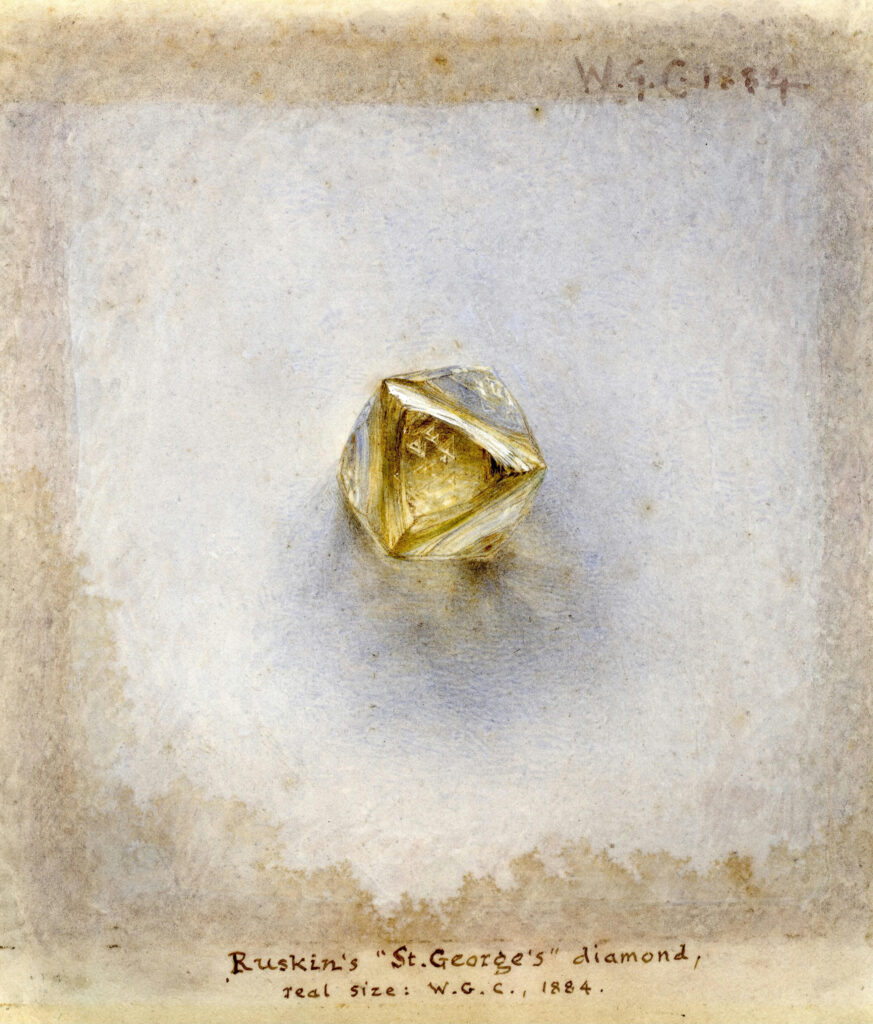
Ruskin was a mineralogist from boyhood, and thanks to the work of scientist Roy Starkey, the extent of Ruskin’s knowledge and collections will be made clear for the first time. Access to the surviving elements of Ruskin’s extensive collection at Brantwood, the Natural History Museum in London, the Guild of St George Collection at the Millennium Gallery Sheffield, the Ruskin Museum, Coniston and elsewhere has enabled hitherto unrecorded connections to be made.
They are the subject of Starkey’s new book, lavishly illustrated with more than 520 photographs and diagrams, including 350 previously unpublished images of specimens from Ruskin’s collection. It tells the story of his long and interesting life, delving into his passion for mineralogy and showing how minerals sustained him through many years of mental illness.
Roy Starkey read geology at the University of Sheffield from 1974-1977 and has been a mineral collector for sixty years. He is a Scientific Associate at the Natural History Museum, London, past-President of the Russell Society, founder of the British Micromount Society and a Companion of the Guild of St George. Author of many articles and papers on British mineralogy he is also a regular speaker to mineralogical and geological societies. He was presented with the Marsh Award for Mineralogy in 2016 in recognition of his scientific contributions and public promotion of mineralogy in the United Kingdom and in 2023, was awarded the British Empire Medal for services to mineralogy by His Majesty the King.
The Mineral World of John Ruskin is his fourth book.
Mounted in partnership with The Ruskin, Lancaster University, the exhibition in Brantwood’s Blue Gallery opens on 3rd July with a private view, and a special introduction by Roy Starkey. It will run until 25th October.
“All Great Art is Praise”
A celebration in words and music of the 200th Birthday of John Ruskin, 1819-1900
Readers:
Michael Palin and Dan Draper
Tenor:
Richard Edgar-Wilson
Coull Quartet:
Roger Coull (violin)
Philip Gallaway (violin)
Jonathan Barritt (viola)
Nicholas Roberts (cello)
Composer, and realiser of Ruskin’s words:
Sarah Rodgers
Visuals devised by Gavin Mackinnon-Little
Performance devised and directed by Robert Hewison
The evening at the Royal Academy was recorded on 8 February 2019
It is introduced by Rebecca Salter, now President of the Royal Academy
A recording of Sarah Rodgers’ “The King of the Golden River”, with Richard Edgar-Wilson and the Coull Quartet, is available at Sarah Rodgers, “Music for Tenor and String Quartet” SOMMCD 222